Friday, December 4, 2020

Other resources for hay

 We have sold out of hay.   Given the hay shortage this year, we are getting an unusual number of calls from people looking for hay, so I wanted to post the following information in case it helps someone.  

https://extension.umaine.edu/livestock/hay/ Cooperative Extension (CE) maintains separate lists of hay and straw producers.  As of early December, a lot of people have sold out.   Speaking only for our little hay operation, we were not able to hay at all in July due to weather, which is when we normally put up most of our hay volume.
 
https://www.facebook.com/groups/414887715356790/
You can post what hay you need and where you are located, and someone may respond.  Also, this Facebook page might be particularly helpful in unusual times, as it can include postings from people who decide to ship hay in from other parts of the country and resell, or small buyers who want to sell what they have for whatever reason.  These folks won't necessarily be on the list maintained by CE.
 
Your Local Feed Store.   Some local feed stores, such as Blue Seal or  Farmers Union, may sell bales of hay.  In normal times, they will usually cost more than buying from a farm, but in a shortage or if you need to drive far to a farm, the price difference may be minimal.
 
This Maine Cooperative Extension Webinar that may be of interest.   Note that you need to register, and can do that from the link.  I'm posting about this webinar before it airs, so I only have the following information from the CE webpage:
 
"Many livestock and equine owners in Maine purchase all of their hay and forage needs for winter. While this year’s growing season started out well, forage growth was reduced due to low rainfall in most of the state, especially for second and third hay cuttings.

This webinar will be presented at 10 a.m. and will be repeated at 6 p.m."

Tuesday, November 17, 2020


Haven't posted in a long time!   

It has been a very busy summer, perhaps because the pandemic pushes one to bring in a bit more hay (now all sold) and expand the vegetable gardens.

Bed #1, on 7/1/2020 (photo to right).   The gardens went in  ahead of schedule, due to a dry and early spring.

We hayed in June, as the hayfields were not their usual boggy spring selves.   Some early baler issues were resolved satisfactorily.   July usually brings most of the hay volume, but rains prevented any July haying.   We necessarily hayed the first two weeks in August, for feed hay.   For whatever reason, the Augusta cut was pretty good. 

After having slightly reduced the size of the vegetable gardens in recent years, the pandemic urged a move in the other direction, and we planted more winter squash that usual.   We filled two hay beds, two large in-ground beds, and six raised beds.

I always try to "plan" that something will not thrive.   That seems a reasonable prediction with organic vegetables.   This year, it was more than one thing, but still not bad given the strange weather.   

There are the summer only eating items, like greens, lettuce, and cucumbers.  We always want to put a lot of brocolli and green beans in the freezers for the winter, along with freezing smaller amounts snap peas, cauliflower, kale, and sliced carrots.   Most of the tomatoes were eaten fresh, but a few were boiled down into sauce.  The Brussels sprouts didn't make it, but made a newly arrived pest happy.

More carrots went whole into the root cellar, along with potatoes and celeriac.   

Dried sage and oregano are in the kitchen cupboards.

The regular cellar now has more than the usual amount of acorn squash, butternut squash, and pie pumpkins.

The other thing that did less well than usual was the onions.   We usually put lots of onions into the cellar, and enjoy them all winter.   The wild turkeys, who normally do no harm, decided to wander and scratch in the small onion seedlings this year.  Oh well.

On plan for next year:   extend fence around the onions. 

Thanks to everyone who bought hay or vegetables this year!  

Wednesday, July 4, 2018

Update on hay beds

Hay bed with young winter squash.

This is a semi-permanent hay bed, right after the insect cover was removed this past week.   It is planted mostly with acorn squash, although there is a gap toward the back, followed by three hills of butternut squash.  The butternut squash vines will fill the gap.

Winter squashes (acorn, butternut, pumpkin) do very well in the hay beds here.   I try to keep enough hay beds maintained so that I can move things around a bit, and leave some hay bed space fallow each year.

The hay beds are semi-permanent.   One year, I accidentally sold the last of the mulch hay, before renewing the hay beds.  I had to let the hay beds go, and start them over when brought in hay the following year.  Hay beds are great for weed control, but they do need new hay added once or twice a year.

It all worked out, because I added manure and some rock phosphate to the overgrown beds, turned them under with the cultivator, and put down new hay sections.    The bed in the picture was turned over last year, and planted again for the first time this year. 

I have a few cabbages in a raised bed this year, and they seem happy there.

Happy Independence Day.

Saturday, October 7, 2017

Tucking in the baler


Today, George and I moved the hay baler into the metal garage.   This is always a tricky procedure, because it has to go in slant-wise, backwards, in order to fit.  The person (George) driving the tractor can't see what he might be about to hit, like the side of a building, so has to rely on someone (me) making hand signals from the ground.

I tend to drop my arms when I want someone to stop, and George expects arms to be raised for a stopping signal.   This can cause minor difficulties.

But, the procedure was a success, and we had a few inches to spare when we fit the farm tractor in beside the baler for the winter.

Friday, September 8, 2017

Mulch hay

We still have hundreds of bales of mulch hay available for sale.  $3/bale at the barn, in good weather.

Broc


The thing I really like about broccoli (broc) is it keeps on producing.  After the first heads have long since been processed into meal sized bags and put in the freezer for the winter, the plants keep making more.

Most of the remaining broc is used fresh in meals here.   But, I always let some keep maturing to yellow flowers.    There are bees that flock to the broc flowers in late fall, long after most wild flowers have gone by.   Have to save some for the bees.

Friday, September 1, 2017

Firewood and cool temps


 I took these pictures three days ago, but I'm still hauling and stacking.   Keep saying "good exercise" to myself.   Will probably be glad this chore is done when it is snowy this winter.   For now, I'm a little sore.


Saw the leaves at right hiding among the greenery.

Now, these are kind of pretty.   But, I need at least another month of warmer weather to get the rest of the garden into the cellar.   The garden went in very late due to the wet spring.   A lingering fall would be helpful.   Forecast says 42 degrees tonight.

Sunday, August 20, 2017

Mulch hay beds and green beans

This is a re-building year for the hay beds, after having to "let them go" last year.   I just finished three long beds.  

Given we're rebuilding, the layout is changing to one that makes it easier to mow, and gives winter squash vines more room to grow.

The beds in these pictures are 6 ft wide and 65 to 70 feet long.   They will sit this year, and some of the winter squash will be here next year.


In the two smaller beds I turned and planted this spring (not pictured), fewer weeds came up than in my regular in-ground beds.  That was a surprise.  Maybe the seed rotted?  I'll have to try this again.

August is string bean season.  I have blanched about 40 pounds of beans for the freezer.   But, we got a new chest freezer recently, so next year I may do more.   They are so much better than frozen beans from the market, in the winter.


Wednesday, July 19, 2017

Mulch hay


Mulch hay for sale.  2017 cut.   Stored in barn or under an overhang.   Please contact us to schedule a  time to come by, so we can be sure someone is available to help.

Monday, December 26, 2016

2016 going to bed


Wishing everyone a peaceful and calm end to 2016.

We're out of hay until we start haying next season.

My sister Cate sent us a "pet blanket".   We've always kept old throws around, but according to our 21 year old cat, this is better.   He is pretty much living under it now.

The bird feeder has been filled, steps sanded, stove wood brought in, and a mid-day hot meal consumed.   Lots of snoozing going on here in the quiet.  I think I'll make some banana bread.

Happy Holidays.

Wednesday, July 13, 2016

Hay

We have mulch hay for sale.   $3 per bale at the barn.  

Stored under a 3-sided overhang or in the barn.

This mulch hay was cut in 2016.   Pls email us to arrange a time to come by, and feel free to inspect the hay before you buy.

Tuesday, July 12, 2016

New views


 The first two pictures show views we didn't have before the trees blew down.

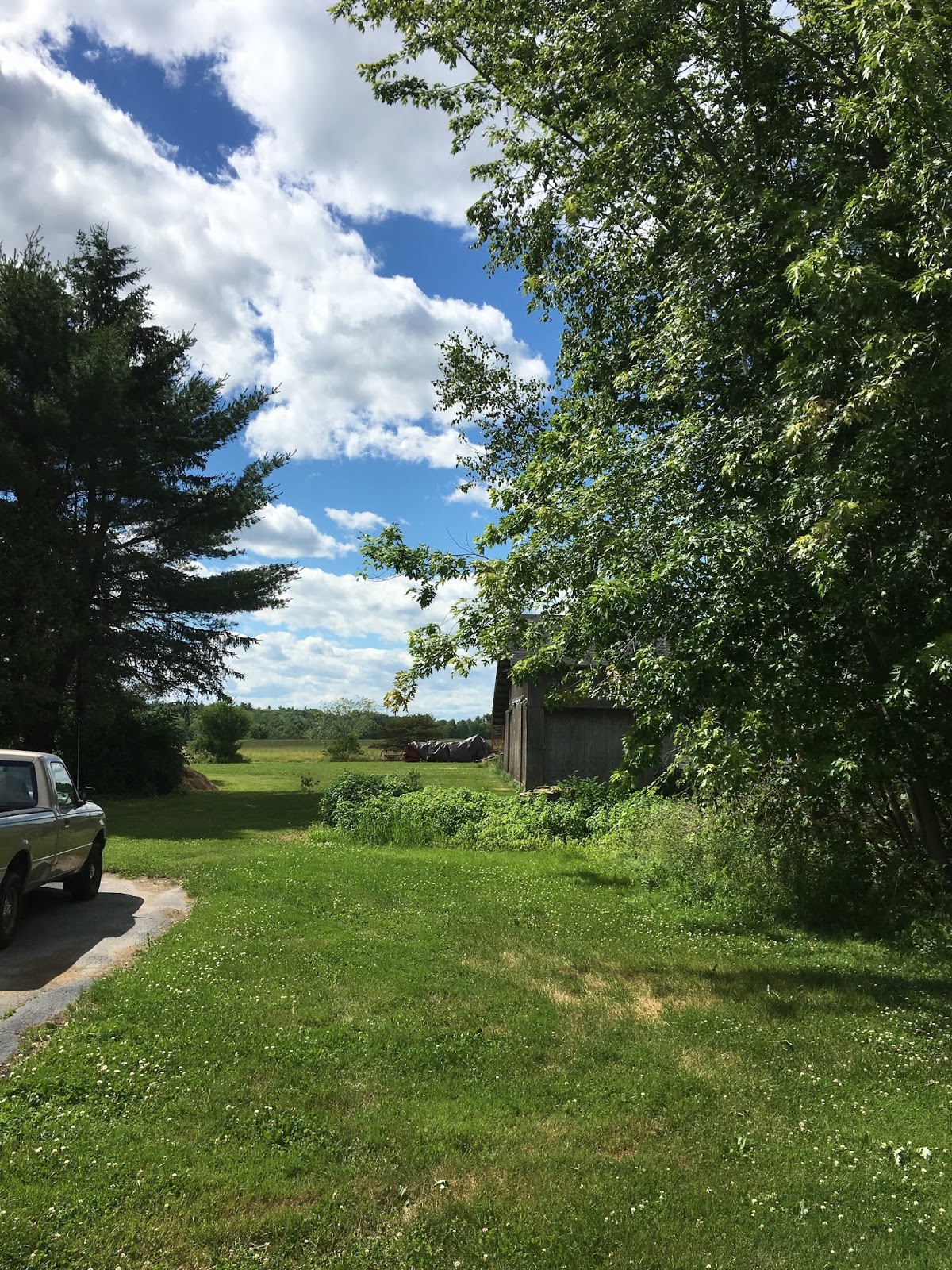
The first view is from the parking area looking toward the kitchen gardens.

The second view is from the parking area looking toward the hay field.

The last picture is looking over part of the kitchen gardens toward the wooden garage.   One of the nice things about a veggie garden is that it is new every year, so the view changes a little.   But the trees blew blew over, I couldn't see this garage from the gardens.

Update on the great tree clean up:

  •  George did most of the chain sawing.
  • We cut everything to 4 or 8 ft lengths and stacked away for future use.   The  smallest diameter 8 ft lengths worked great for holding down row cover in the kitchen gardens this year.
  • I cleaned up all the branches except for 2 piles.  Piles were left in various places for wildlife habitat.


Monday, April 11, 2016

Wind


Underside of cedar
There was a lot of wind and rain a few nights ago.

Usual stuff mostly:  no power for awhile; I worried about the veggies warming up in the freezer; and family members said things like "Wow" and "Hear that?"

In the morning, I glanced out the kitchen window and noted "several trees down".

If we hadn't had such sodden ground combined with all that wind and rain, the trees would probably still be standing.

A friend commented later that day: "You people got very lucky last night."   Yes, we did.

The trees missed all buildings, vehicles, and farm equipment.  One missed the hay barn by less than a foot.

This one just missed the hay barn.
Yesterday evening George gave me a lesson in using a chain saw.   I've spent years avoiding chain saws, but it was time to get over myself.   If I can run a cutter (for hay), I should be able to use a chain saw.

Wow, they are both scary and cut wood like butter.


These trees are lying in Vegetable Bed #1.

Saturday, December 12, 2015

In spite of the hail this season

Some of the onions in storage


George and I put up extra hay.   Thanks to everyone who bought hay from us!   They hay is crucial to keeping the farm going.

After the hail storm, the kitchen plots came back better than one might have hoped.   The unusually long growing season allowed some plants to recover.

There are plenty of onions for winter.  Some winter squash hit by hail developed rot spots.  But, once the plants recovered, new squash emerged.

There are lots of packages of string beans, sliced summer squash, and broccoli florets in the freezer, along with bags of hot peppers, and a small bag of processed horse radish.   George keeps advocating for more peppers and horse radish in the food.

I kept a few sugar pumpkins for cooking experiments.

Fresh carrots and potatoes are in the root cellar.

Three varieties of garlic were planted this fall, and George asked if I wanted more raised beds made.

Looking forward to next year!

Friday, August 7, 2015

Hail

Pic 1.  Stormy sky to west

We had a couple of days of stormy weather recently.  At right is a picture of a storm that rolled in on August 4th, in the afternoon.

On August 5, we had a very similar afternoon storm, but with the addition of hail.   The hail lasted less than a minute, and was not particularly large.  But, it did an amazing amount of damage to the kitchen vegetable gardens.
Pic 2.  Part of Bed #2, before the hail


Picture #2 is of part of Bed #2, a few days ago before the storms.  Three rows of onions are on the right edge, all standing up nice and straight. 
Pic. 3.  Onions, after the hail
The last picture is of some onions after the hail storm on August 5.      We normally put enough onions in the cellar to last us well into the spring, so it would be unfortunate to lose all of these.

Almost everything in the kitchen gardens is affected to some degree by the hail storm.   

On the bright side, today there are three or four big heads of broccoli ready to pick and blanch for the freezer, zucchini bread with walnuts and chocolate cooling on the kitchen counter, and someone dropping by to buy a bit of hay.

Monday, June 22, 2015

Follow up on last entry about my dad


I'm working on an inventory of boxes and boxes full of miscellaneous things that weren't consider of monetary value by folks who helped break up my parents' last apartment.  Some of it is so lovely, in terms of letters, articles, and family photographs.  I have a lot of scanning to do.

I mentioned my father, John Richardson, in the last post.   I never talked about him with people I know because he was a modest man.  

I came across this material buried in an old box, and I know it was just the start.

The following excerpt is from an editorial in Life Magazine (November 24, 1958).

The events occurred during the height of the Cold War.   Here are links to some contextual history on the 1956 protests in Poland and the Polish October from Wikipedia.

Excerpt:

"Soon after the bloodless Polish revolution of October 1956, a self-starting young Wall Streeter named John Richardson Jr. began to hear about the crying shortage of modern medicines in Poland's grossly mismanaged economy.  He got up a committee of private citizens who saw both the humanitarian and the political point of helping to sustain Polish morale in a tough time.  With help from other private organizations who had contacts in Poland, notably CARE, Richardson made three trips to Poland and finally won the agreement of the Polish government to accept and distribute American medicine as a gift, clearly labeled as such, from the American people.  The American people in this case, also prodded by Richardson's committee, are chiefly some 20 pharmaceutical manufacturers who have contributed more than $2 million worth of drugs, including 900,000 polio vaccine shots.

The impact of this common sense generosity on the Polish people has been terrific.  To the accompaniment of grateful newspaper headlines, more than two million Polish schoolchildren are getting polio shots this fall.  For the free vaccine stimulated the Polish government to buy five million additional shots from U.S. sources.  As a result more Polish kids are getting vaccinated than Russian kids.  (There is practically no vaccine in the other satellite countries.)

Other individuals besides Richardson deserve credit for this project, too many to list here.  It was no easy job to raise the contributions, arrange for their delivery and get the Communist government to concede safeguards for their nonpolitical use.  The men did it, however, and on their own, with the approval but not the assistance of the U.S. government.  We hear a lot these days about "people-to-people" diplomacy.  This Polish Medical Aid project (address:  25 Broad St., New York) shows what it consists of."

Sunday, June 21, 2015


Just wanted to say "Miss you Dad" to my father on father's day.   He passed away the day after Christmas, 2014.

Image:  John Richardson, Jr. as a young man.

Wednesday, April 15, 2015

Counting signs of spring (3)


Pic 1.  Elderly house cat trying to make a break for the outside world.

He may have known that the swallows who nest in the barn arrived back this morning.  I might have let that slip.


Pic 2.  Finally!!  The hay tedder has gotten its head out of the snow bank where it has been held captive all winter.  You can just see it to the left of the hay wagon.
Pic 3.  The first crocus of spring is up, and it didn't get squashed by the bear (or very big raccoon?) who walked off with our bird feeder last night.

Bird feeder still on the missing list.


Saturday, April 4, 2015

Counting the signs, continued


 1. Banded woollybear catepillar has been on the front porch for a couple of days.  Most of that time he/she was on the welcome mat.   He/she could be older than most of the kids who have stayed with us.  We are treading carefully.

2. Summer sparrows were at the feeder yesterday.

3. The two raised beds in the front yard poked out of the snow yesterday, and are easily seen today.

4. The wild turkeys are now making semi-routine visits.

5. A big flock of something filled up the trees across the road this morning, but we don't know what they are yet.

6. Seedlings are coming along in the basement.  Germination was slow and uneven this year, possibly due to the unusually dry basement.  I don't think the problem was the seed.

7. First ladybug sighted indoors last night, in the bathroom, on the cap of my mouthwash.   Spunky lady. 

Oh, it just started snowing.   Kind of pretty, in that pretty kind of way when it is special because it won't last long.

Monday update:

On Sunday, when George and I were coming up the drive, a small group of robins arrived in a snow squall.  Seeing those spring bits of red swirling in all that white was exciting for us, but we worried about them finding food that day.   I haven't seen them since, although there is some bare ground now.

Checked around mid-day, and the tedder is still completely hidden under deep snow.   A tedder is a piece of haying equipment that spreads and fluffs cut hay, and looks like a large spider. 

I emailed George about the tedder, and he joked that maybe "it has tedded itself into hibernation and is buried ten feet below ground level."   Would hate to be around when it crawls up!

Saturday, February 28, 2015

Counting the signs


We snow blow rather than plow, so we don't have
those big mounds thrown up by plows.  Pretty good
depth anyway though.
I didn't used to get the whole "cabin fever" issue.   When I looked after a flock of sheep, the ram went in with the ewes around Thanksgiving.

After that point, it felt like spring was driving in fast.  Every day, dark and intense eyes looked at me, triggering a sense of responsibility for the bellies getting gradually bigger.   The lambs were coming!   I had to get ready!

Without the sheep here, spring can seem a long way away.   So, I have to count the signs.

George thinks that the dull gray/brown gold finches at the feeders are starting to show some yellow.    I am planting the onions seed (inside) this weekend.   George is going to do a bit of catnip seed.   

On the other hand, IF&W relocated a hungry bobcat, who was munching on house cats.

Spring.  Coming.   Must be.